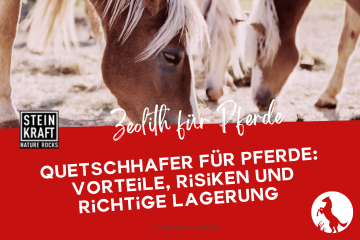
When the days get shorter, the grass grows more slowly, and the grazing season slowly comes to an end, more than just the place where our horses spend their days changes.
In the spring, we naturally talk about turning out onto pasture. We know that horses should be gradually accustomed to the young grass.

But what actually happens at the other end of the grazing season?
The journey from pasture back to more hay and roughage is also a dietary change. And during this, the horse's gut also needs time to adjust to the changed feed availability.
Therefore, taking horses off pasture in autumn is not an abrupt boundary between summer and winter for us. A slow transition is much nicer – and more horse-friendly.
In a nutshell: What is important when taking horses off pasture in autumn
- The switch from grass to hay is also a dietary change.
- The horse's gut and its microorganisms react to changes in the ration.
- Hay should not be offered only when there is practically nothing left to eat on the pasture.
- Roughage remains the foundation of a horse-appropriate diet.
- Changes in manure, eating behavior, water intake, and general condition deserve attention during the transition period.
- Concentrated feed should not be increased automatically just because the grazing season is ending.
- The less abruptly the diet is changed, the more time the digestive system has to adjust.
What does taking horses off pasture mean?
Taking horses off pasture, or moving them off grazing, refers to the transition from summer pasture keeping to autumn and winter feeding.
Depending on how they are kept, this can look very different. Some horses return from all-day grazing to a paddock or an open stable. Others continue to stay outside for a few hours but find less and less grass there. Others switch relatively suddenly from pasture grass to a ration consisting mainly of hay. This is exactly why it is worth looking at the end of the grazing season as more than just a change in management.
It is also a change in feeding.
And thus, it directly affects the horse's digestive system.
Why grass and hay are not the same for the horse's gut

Although grass and hay consist of the same plant, they are not nutritionally identical.
As the plants mature and undergo preservation, the feed changes. Fresh pasture grass contains a lot of water. Hay contains significantly more dry matter and is consumed differently.
The composition of the available nutrients and plant fibers also differs.
For us, the change might look simple:
Grass yesterday. Hay today.
For the digestive system, it means a new ration that it must adapt to.
The horse's large intestine thrives on microorganisms
Horses can only utilize a significant portion of their fiber-rich food because a large community of microorganisms works in the cecum and large colon.
Bacteria and other microorganisms ferment plant fibers and, in the process, form short-chain fatty acids, among other things, which serve as an energy source for the horse.
This microbial ecosystem is adapted to the existing feed. If the ration changes, the food supply for the microorganisms also changes.
This is not unusual in principle. Horses and their microbiome can adapt to different feeding situations. The decisive factor is the speed.
What does research say about switching between grass and hay?
An interesting study looked at exactly this question.
Six ponies were switched either abruptly from free pasture to a ration consisting exclusively of hay or in the opposite direction from hay to grass. The researchers then studied the composition of the microorganisms in the manure over 14 days.
The result:
The abrupt switch between grass and hay led to measurable changes in microbial composition.
Particularly interesting for our autumn: The changes were not identical, depending on whether the ponies switched from hay to grass or from grass to hay.
This reveals something that is sometimes overlooked in daily stable life:
Taking horses off pasture is not just "turning them out in reverse".
Both are dietary changes – but the horse's gut reacts differently to each direction of change.
The study with six ponies was small and deliberately examined an abrupt change in feed. It therefore does not provide a guide on exactly how many days a horse must be taken off pasture. However, it clearly shows that switching from grass to hay represents a genuine change even at a microbial level.
Do horses need to be taken off pasture gradually in autumn?
In many stables, nature does part of this work by itself.
The grass grows more slowly, the available amount of grass decreases, and at the same time, hay is increasingly offered. This can lead to a fluid transition.
It becomes more problematic if a horse consumes large quantities of pasture grass until the very end and then receives almost exclusively hay within a short time.
Therefore, the question is less:
"How many minutes do I have to take my horse off pasture?"
And much more:
"How can I make the transition from grass to hay as calm as possible?"
Offering hay before the pasture is empty
A sensible transition does not begin on the last day of grazing. If the grass supply decreases, hay can increasingly take over part of the roughage supply.
This allows the digestive system to be familiar with the winter roughage before the pasture is completely gone.
At the same time, timely adjustment of the roughage supply prevents horses from spending hours searching for the last green blades on grazed-down areas, where their actual feed intake is difficult to estimate.
It is not the calendar that decides how much roughage a horse needs – but the actual feed availability.
Autumn pasture: A large area does not automatically mean plenty of feed
A pasture can still look wonderfully green in autumn and yet offer significantly less usable plant mass than a few weeks before.
For horse owners, it is therefore not only crucial what the pasture looks like, but how much the horse can actually ingest there.
This becomes especially important if a horse spends a lot of time outside.
After all, many hours of grazing time do not automatically mean many hours of sufficient roughage intake. As soon as the natural supply decreases, the supplementary roughage supply should match the actual situation.
And what about fructan in autumn?
Hardly an autumn passes without fructan being discussed among horse owners. A nuanced view is worthwhile here.
The fructan content of grass is not a fixed quantity. It depends, among other things, on the plant species, growth conditions, time of day, temperature, and sunlight.
Therefore, the simple rule "autumn grass is always high in fructan" is too simplistic.
Especially for horses with metabolic diseases or an increased risk of laminitis, pasture usage should be coordinated individually with veterinarians or qualified nutritionists.
For healthy horses, the same applies: do not focus on individual keywords, but rather on the entire ration and the individual horse.
Does my horse automatically need more concentrated feed after being taken off pasture?
No. Less grass does not automatically mean that more concentrated feed is necessary.
First, it must be determined how much energy and nutrients are being absorbed through the new roughage ration and what the horse's actual requirements are.
An "easy-keeper" recreational horse has different needs than a sports horse, a growing young horse, or an old senior.
Therefore, the transition from pasture should not work according to the principle:
Grass gone = add concentrated feed.
The basis remains a need-based supply of roughage. Everything else is determined by the horse, performance, body condition, and the quality of the overall ration.

What does the shedding of the coat have to do with it?
Taking horses off pasture coincides with another major seasonal change: growing the winter coat.
This makes autumn a special transition period.
The shedding process itself, however, is a topic of its own. If you want to know when the autumn shedding begins, what changes you can observe, and how you can support your horse during this time, you can find our detailed STEINKRAFT Shedding Guide.
This way, we can look at both separately in autumn:
What is happening on the outside with coat and skin?
and
What is changing on the inside due to the new diet?

Fecal water during the transition – are they related?
Changes in manure consistency can be noticeable during a dietary change.
However, fecal water has many possible influencing factors. Therefore, it would be too simple to attribute fecal water in autumn exclusively to the switch from grass to hay.
It is interesting, however, that studies on fecal water in horses show that the type of roughage, the composition of the ration, and individual reactions to different feeds can play a role.
If your horse suddenly develops fecal water in autumn, it is worth taking a close look at the entire situation:
What has been changed? Which batch of hay is being fed? What does the overall ration look like? Has the management changed at the same time?
You can find everything about possible influencing factors, current research, and the distinction from diarrhea in our comprehensive guide on fecal water in horses.

Observe the transition – instead of just feeding by the schedule
No feeding plan knows your horse as well as you do. Especially during the transition off pasture, it is therefore worthwhile to consciously observe a few things:
What do the manure balls look like?
Does your horse eat its hay happily and calmly?
Has the water intake changed?
Does the belly appear bloated or unusual?
Is the weight changing?
What is the general condition?
Small changes do not have to be automatically problematic. However, significant or persistent digestive problems, pain, loss of appetite, or signs of colic should be investigated by a veterinarian.
HORSEKRAFT Zeolite during dietary changes

A dietary change should always first be supported by good feeding management. Zeolite does not replace high-quality roughage or a gradual dietary change.
HORSEKRAFT is a high-quality clinoptilolite zeolite and is used as a technological feed additive. Its special microporous structure allows it to adsorb certain substances in the feed or the digestive tract.
Especially during transition periods, many of our customers therefore use HORSEKRAFT as a supplement to their daily feeding.
For us, the sequence is important:
Check roughage supply. Change feed slowly. Observe the horse. And optimize the feed in a targeted manner.
Not the other way around.

Anyone wanting to use zeolite while taking horses off pasture should follow the feeding recommendation, ensure sufficient water intake, and observe the necessary time interval from medications and other dietary supplements.
We deliberately do not explain our exact dosage again here – that is what our own HORSEKRAFT Dosage Guide is for.
Turning out and taking off pasture – two sides of the same annual cycle
In spring, we look forward to the first green blades. We count minutes, observe the grass, and slowly lead our horses to the pasture.
In autumn, the transition often happens much more quietly. The pastures become emptier. The hay returns. The days get shorter.
Perhaps this transition deserves the same attention.
After all, horses live much more directly in the rhythms of nature than we do. Their coat changes, their feed changes, and their daily routine changes with the seasons.
Mindful horse feeding therefore does not mean trying to avoid every change. It means giving the horse enough time to adjust to change.
And sometimes good horse feeding begins exactly with that: looking before something becomes a problem.
Questions & answers about taking horses off pasture
❓Do I even have to take a horse off pasture if there is less and less grass in autumn anyway?
Not necessarily according to a rigid "off-pasture plan". If the grass supply gradually decreases and hay is increasingly offered at the same time, a natural transition can already occur. It is crucial that the change in the ration does not occur unnecessarily abruptly and that the roughage supply remains sufficient.
❓Should I offer hay on the pasture already?
If the available amount of grass is no longer sufficient, supplementary hay can be useful. The actual intake of the horse should be considered. A large, green area alone tells us little about how much usable feed is available there.
❓Is taking horses off pasture the same as turning them out – just in reverse?
No. Both processes are dietary changes, but grass and hay differ in their properties and the change occurs under different conditions. Studies also show that the microbial reaction to the switch from grass to hay does not simply mirror the switch from hay to grass.
❓Can I simply replace the last of the pasture grass with concentrated feed?
No. The end of the grazing season does not automatically mean a higher requirement for concentrated feed. First, ensure an adequate supply of forage and evaluate the entire ration based on the individual horse.
❓How do I know if there is not enough forage left in the autumn pasture?
Appearance alone is not enough. The decisive factors are plant biomass and actual feed intake. Horses that forage for a long time, graze the grass cover very short, or lose weight despite spending many hours at pasture may be signs that the available supply is no longer sufficient.
❓Should I also change over slowly when switching to a new batch of hay?
If organizationally feasible, a transition between two significantly different batches of forage can be sensible. Horses can react individually to changes in forage. Especially with horses that have sensitive digestion, it is worth monitoring changes consciously.
❓Does a horse need to drink more in autumn when it eats more hay again?
Fresh grass contains significantly more water than hay. Therefore, with increased hay consumption, less water comes directly from the feed. This makes access to clean, fresh drinking water at all times even more important. Keep a particular eye on horses known to drink little.
❓My horse stays out in the pasture even in winter – does this topic still apply to me?
Yes, if the composition of its ration changes. "Moving off pasture" does not have to mean that the horse leaves the pasture entirely. Even with year-round access to pasture, the importance of supplemental forage increases as soon as the grass supply is no longer sufficient.
❓Can I start using HORSEKRAFT before the grazing season ends?
HORSEKRAFT can be integrated into the existing feeding regimen. The key factors are the correct dosage and legal requirements for feed additives. However, a slow and needs-based change of feed does not replace zeolite.
Science & Sources
Garber et al. (2020): Abrupt dietary changes between grass and hay alter faecal microbiota of ponies.
Using six ponies, the study shows that abrupt changes between grass and hay were associated with changes in the composition of the fecal microbiota. Especially interesting for the end of the grazing season: the change from grass to hay showed a different pattern of change than the change from hay to grass.
Further reading at STEINKRAFT

→ Horses to pasture – changing feed in spring
→ The horse's gut – how it really works
→ Shedding in horses – spring and autumn
→ Fecal water in horses – causes and possible contributing factors
→ Correct dosage of HORSEKRAFT zeolite

About the author
Andreas J. Pfeiffer
Co-Founder STEINKRAFT | Horse owner for 30 years | Open stable in Schleswig-Holstein | Now in Austria
Andreas writes from real, everyday stable experience. Three decades of horse ownership on his farm in Schleswig-Holstein – leisure and competition horses, self-built open stable, he has experienced it all himself. Today he lives in Austria and runs STEINKRAFT together with his wife, Michaela – the stable in Northern Germany continues to operate, and the passion for horses has never ceased.