I wanted a girl. I even had a name for her: Lilly. Lilly-the-dog – that was always clear, somehow. If I ever got a dog, it would be a female, and she would be Lilly.
What you'll find in this article:
How Ezra came to us – and why he was actually meant to be named Lilly · The two weeks on the floor · Once in a lifetime called Lockdown · What got chewed up · Steffi and the two fingers · The kids with the hoodies · The watering can · How Ezra changed our lives · And what no guide in the world tells you beforehand 🐾🧡

It was never the right time. Either all the puppies were already taken, or we were traveling too much, or life just had other plans. Until spring 2020. Then everything changed anyway.
The lockdown. The world stood still. And suddenly we were always at home – Andreas and I, strangely precious and together with much learning and new experiences. I shifted my workshops and coaching online, and suddenly, we had a dog.

Because: The breeder had called us the Saturday before. She still had a male puppy. One of her puppies was supposed to go to England for breeding – a nice plan until the lockdown came, and the dog couldn't go to England anymore. She called that evening. And we had to decide quickly. She already knew us, and we knew the puppies because we had already looked at the reserved girls. And so Ezra came to us. Not Lilly. Ezra. A male. Our male.
Ezra means "help through God" – in Hebrew. I only found that out later when I looked up the name. Because we found it fitting for these uncertain times. Because that's exactly the right name for our boy. 🧡 For a short while, I wanted to call him Poldi, but everyone was against it. Even those who shouldn't have cared.
Eight Weeks and a Day – and Two Weeks on the Floor
 We picked him up when he was eight weeks and one day old. The breeder had tears in her eyes – not dramatically, not loudly, just the way you cry when you let go of something you love and have brought well into the world. She gave us a blanket, a red one with her scent, with the scent of his siblings, with everything Ezra knew and would soon no longer have. So that he wouldn't be completely alone with the new in the first night. That was her way of saying: I trust you. Take care of him. We promised her. On the way home, I wrapped him in the blanket like a baby and was terribly excited.
What he could already do at eight weeks and one day: love small cucumbers. And sheep yogurt. The vacuum cleaner – he was already used to it, the breeder had done an excellent job. He knew the hum, he knew the chaos, he knew life in a house with many people and noises. And he was house-trained.

What he then experienced: everything different. New smells. New people. New home. No more siblings. No mother. Only the blanket with the familiar scent – and Andreas.
Andreas slept on the floor and sofa for two weeks. Next to the crate. Yes, also on the floor. Not one night, not three – for two weeks, every night, no ifs or buts. When Ezra whimpered, Andreas was there. Immediately. Always. Every time.
 That sounds sacrificing – and it was. But it was something else too: It was the foundation. In these two weeks, Ezra learned the most important thing a young dog can learn: If I call, someone comes. If I'm scared, I'm not alone. If I have to pee at night, we go outside. The world is new and strange and sometimes loud – but there's someone who stays.
What no one tells you beforehand: These first nights are not just important for the puppy. They are important for the relationship. For the trust that is built in these quiet hours, when no one is watching and no one notices, except a small dog and a person on the floor who is simply there.

Andreas never talked much about it. He just did it. That's his way. And Ezra – help through God – never forgot it. 🧡 And by the way, they still lie next to each other today. Being at the same height is important to both of them now.
A Childhood That Happens Only Once – Once in a Lifetime Called Lockdown
Ezra had a special childhood. One that can only happen once – because the circumstances that made it possible will never be repeated. That's how I see it.
We were always there. Around the clock. Not because we had planned it, not because we were particularly disciplined or had a perfect training plan – but because the world stood still for a short, strange, precious time, giving us something that cannot be bought: time. Infinite time with a little dog who had just arrived.

And we used it. Due to the lockdown, there was no puppy school, but there was Steffi, who came to our house. At least a hundred "sit" commands every day. A hundred "stay" commands. Not because we wanted to break records – but because we had understood that a dog that learns is a happy dog. Dog trainer Steffi – our Hundeflo-Steffi. She didn't just train; she explained, she didn't just correct; she showed and explained everything very precisely from the beginning. How to practice. When to stop. How to celebrate successes. And we trusted her and did exactly that.
What happened was one of the most beautiful things I have ever observed: Ezra's joy in learning. He rejoiced with us when he mastered something. You could see it – in his body, in his gaze, in that special lightness that arises when a being realizes: I understand something. I can do this. I belong. I know what you want from me.
Learning was not a chore for Ezra. It was connection.

And then there were the children – visitors, neighborhood kids, the little humans who wanted to lead him on the leash. Ezra always looked at us. That gaze that says everything without a word: Do I really have to? Really with them? Without you?
And we looked back and said: Yes. You can do it. We're here. That's part of it. Part of our life.
He managed it every time. And afterwards, he always came back to us proudly – in his calm, clear Ezra way, without drama, simply: here I am again. Did you see? 🐾

Looking back, we are very happy about that time. About the discipline we had, the hundred times daily, the patience, the close observation. Not every dog gets that. Not every person has the opportunity to give it like that. Once in a lifetime called Lockdown. And we made good use of it. 🧡
The Guilty Conscience – Has Anyone Told You About It Before?
Not me. This persistent, quiet feeling that settles in like an uninvited guest: Am I doing enough? Am I present enough? Should I do more with him, go for more walks, play more, or just sit and be there?

Ezra quickly learned to endure 90 minutes. A coaching session – that's my unit of work, it just settled that way – and then there's a break with him. That was our agreement, unspoken, just happened, like many good things in life just happen if you're attentive enough. After 85 minutes, he reminds me by stretching and doing yoga next to me. Alright. Time to wrap up.
He often lies next to me while I work. Sleeps. Breathes calmly. Is simply there – and that, as I slowly understood, is already enough. He doesn't reproach me. He looks at me when the 90 minutes are over – calmly, attentively, waiting. Not demanding, not dramatic. Just ready.

You don't have to be a psychologist to guess that guilt is one of the most common companions of dog owners, especially at the beginning, especially when you have a dog for the first time, especially when you work and can't always be there. And I tell you what I told myself: He doesn't need all your time. He needs your attention when you are there. That's a difference.
What was chewed up – and what it actually means

A Labrador Retriever puppy in lockdown, in a house where someone was always present, where everything was reachable, interesting, and potentially chewable. Charger unplugged. Not funny. Every new stuffed animal torn to shreds. Then Andreas bought him one made of very, very strong imitation leather. It lasted 2 hours. My new hiking boots - the insole was fun for him. He chewed through the muzzle multiple times – again and again, with great consistency and impressive thoroughness. Eventually, we stopped buying new ones. 😄

What no one tells you beforehand: Chewing is not defiance or bad training. Chewing is development – a puppy that chews explores the world, it learns what things are, how they feel, whether they yield or resist. Teeth are its most important tool at this stage, its laboratory, its way of understanding the world.
Of course, that doesn't help much when your favorite shoe is being destroyed. But it helps with understanding, and understanding helps with reacting – more calmly, more composedly, with less drama than you might wish for in that moment.
Steffi, two fingers, and why we are all allowed to be different
Andreas and I don't do it the same way. Andreas is calmer, more structured, has had dogs his whole life, and sometimes knows what to do without thinking. I'm a psychologist – I analyze, I question myself, I sometimes doubt in the moment when certainty would be more helpful. I do things differently than Andreas, with different words, a different tone, a different reaction. Even "heel" is on the other side for me.
And then there's Marika, who has her own unique way of interacting with Ezra – and whom he loves so much, in his calm, clear Ezra way.
Steffi, our dog trainer, told us something that really relieved me, so much so that I wrote it down: Everyone is allowed to have their own style. Andreas, Michaela, Marika. And Grandma and Grandpa do it differently again. Ezra has to learn that people are individuals. That's not confusion for him – that's socialization. That's the world.
 A dog that only interacts with one person in one single way is not a well-socialized dog. A dog that learns: Steffi does it this way, Andreas does it that way, Michaela does it differently – and I know how to deal with everyone – that is a dog that understands the world and finds its way in it. And he loves playing ball.
What Steffi specifically taught us: two fingers, gently but firmly nudging him when he does something we don't want. Don't yell, don't dramatize, don't explain endlessly. Two fingers. And redirect. Again and again, patiently, consistently – each in their own way. And if he has something in his mouth that we don't want him to carry, distract him with something else and replace it. That works 1000 times better than a hysterical GET OUT.
The Kids with the Hoodies – Ezra's Greatest Lesson About the Brain
Kids teased him through the garden gate with sticks. Kids in hoodies, of a certain size, with a certain silhouette. Since then, Ezra growls at all hoodie-wearers of that size – calmly, clearly, unmistakably.

This is not malice or bad training. This is classical conditioning – the same principle Pavlov discovered with his dogs, only this time with hoodies instead of bells. The brain made a connection: beings of this size with this hood equal caution, potential danger. And it never forgot this connection, because that's how the brain works – it stores what was important, what required protection, what was once unpleasant.
What no one tells you beforehand: Dogs learn from a single experience. Once is enough. What happens as a puppy often shapes them forever – not because dogs hold grudges, but because their nervous system is particularly receptive at this stage. It quickly decides: safe or not safe. And that decision runs deep.
This is an invitation, not an accusation: In the first months of life, create as many positive experiences as possible. With people in hoodies. With bicycles. With children. With noises. With everything the world has to offer – because it's precisely in this phase that the brain decides what is normal and what isn't.
The Watering Can – and why some things run deeper than words can reach

Once, Ezra was hosed down with the garden hose – with anger, with disappointment, in a moment when someone, it was Andreas, was overwhelmed. Ezra had jumped into the super-dirty puddle in the vineyards – naturally, along with the other dogs who also loved it – and Andreas was furious. He held the little muddy one up and showered him all over. Just once. The brain decided: water from above with negative energy equals danger. And it never revised that decision. Ezra is a water dog. He'll swim in any stream at any temperature. When I show up with the watering can, he quietly walks away. Far away.

No conversation changed that, no explanation, no matter how loving the subsequent repetition with the watering can when everything was nice and calm. Once was once too much – and that is both fascinating and instructive, because it shows us something we sometimes forget: Some things run deeper than words can reach. In the nervous system. In the body. Beyond reason and explanation. And I have no chance of talking to him about it. That he might understand Andreas' perspective and empathize a little with his human.

A Harvard University study showed that stressful experiences in the first months of life influence dog behavior as strongly as gender, age, or neutering – sometimes even more so. Dogs that had negative early experiences showed significantly more fear and caution in adulthood, regardless of how loving their subsequent lives were.
We have words, we have therapy, we have the ability to say, that was then, I am no longer that today. Dogs don't have that. They carry what they have experienced – in their body, in their behavior, in reactions that sometimes appear and leave us puzzled. That doesn't make them weaker. It makes them somehow more primal.
When Work Started Again

The first period was different from anything that followed. We were always there; Ezra knew nothing other than people at home, a world that revolved around him and in which he was never alone.
Then the lockdown ended. Mr. H. had to go back to Germany, I was on the road more often, life returned to normal. And Ezra had to learn what he hadn't known before: now only one of us is here.
Ezra learned it – with time, with routine, with Marika, with the reliable knowledge that people always come back, without exception.
When Andreas puts the suitcases in the hallway, Ezra lies down next to them. Guards them. Offended. Sad. As if he could prevent them from leaving if he only paid attention long enough and guarded them well enough. He can't, we both know that, but he still tries – every time, with the same quiet determination. That is love. Without words, without explanation, simply: I don't want you to go. And I'll show you as best I can.
How Ezra changed our lives – quietly and fundamentally

There are changes you plan, and changes that just happen because another being enters your life and you realize you see the world through different eyes.
We don't fly anymore. We bought a bus – a real one, with a huge crate inside, where Ezra can travel comfortably, where he has his place, where he knows he's coming along and won't be left behind. That wasn't a difficult decision. It wasn't really a decision at all – it was a matter of course that just happened.

We only go to restaurants where dogs are welcome. We only visit friends where dogs are welcome. Sounds like a restriction – feels like freedom. Because suddenly you know what's really important and what isn't, because you stop making compromises that don't feel right, because a dog reminds you in a very direct way that life with beings you love is richer than any restaurant without them.

The first New Year's Eve, we were very careful. Not out of fear – out of responsibility. We were invited to Anna and Heinz's, and Ezra lay on a soft blanket – all prepared by Anna. We made sure he wasn't afraid, that he could handle the fireworks well, that he knew: it's loud, but you're safe, we're here. That's one of the most beautiful lessons a dog teaches you – that sometimes you just have to be there. Calm. Present. Without saying much.
Perhaps that's the most beautiful thing a dog teaches you: to think ahead. Not for yourself – for someone else. 🐾
Zeolite – from the beginning, because care starts early

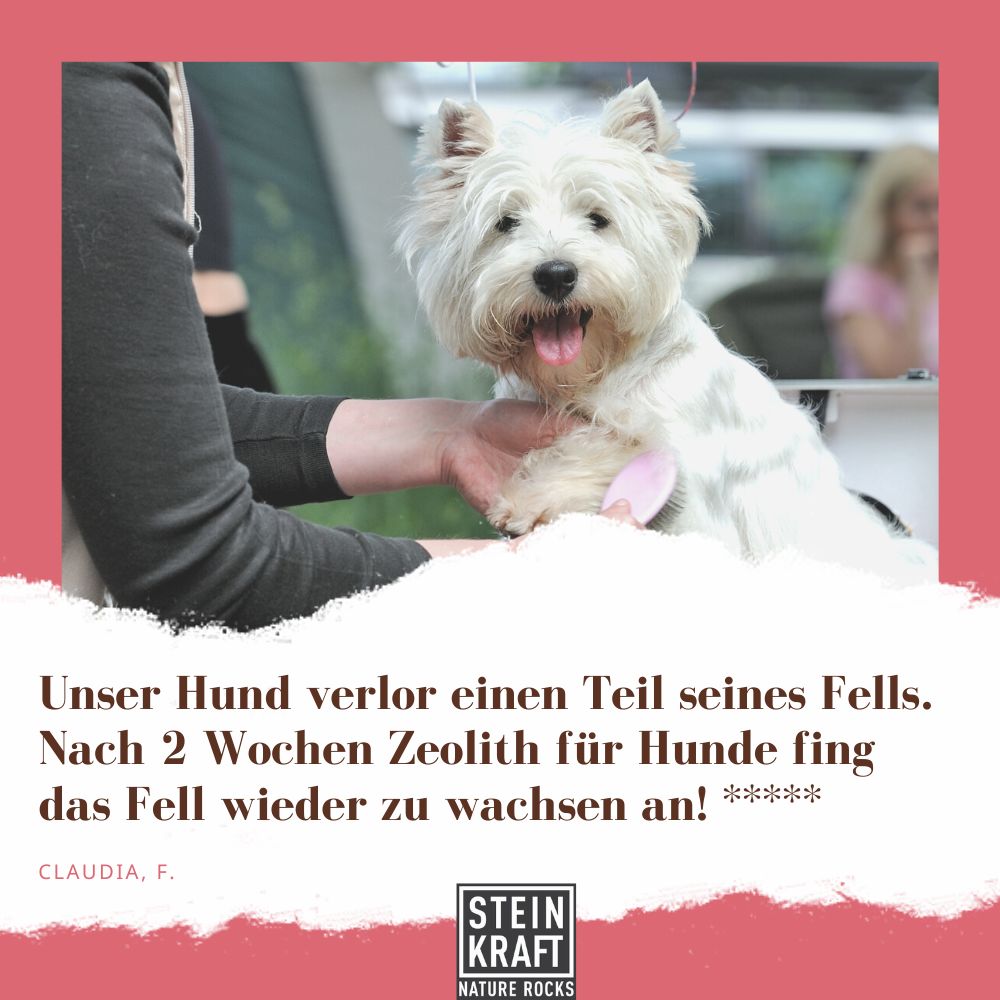
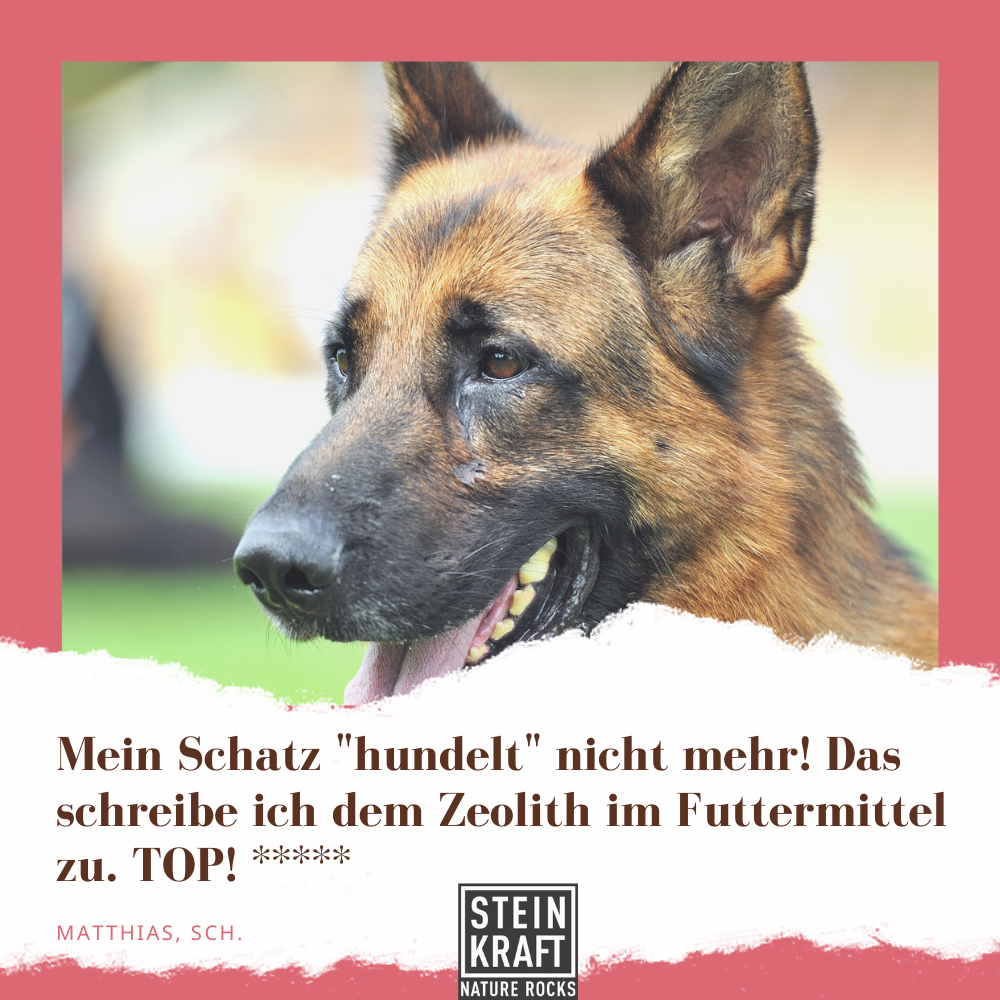
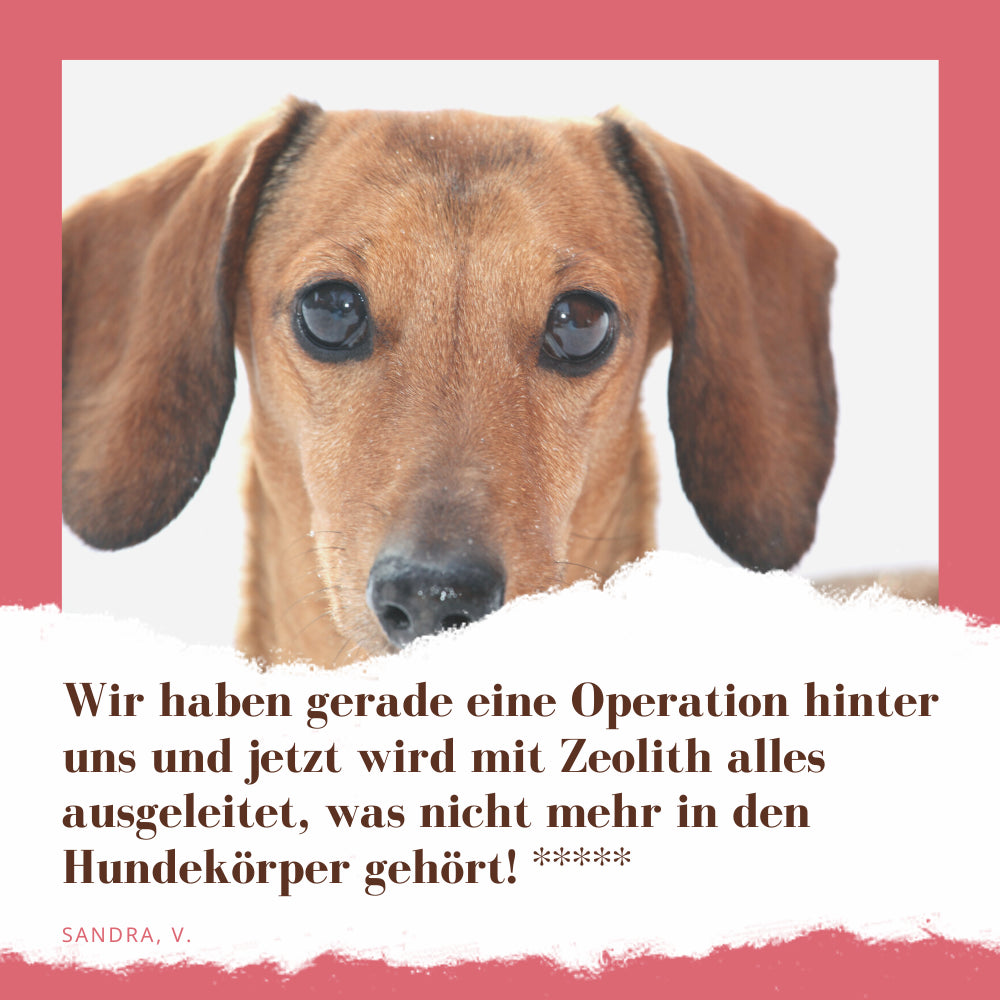
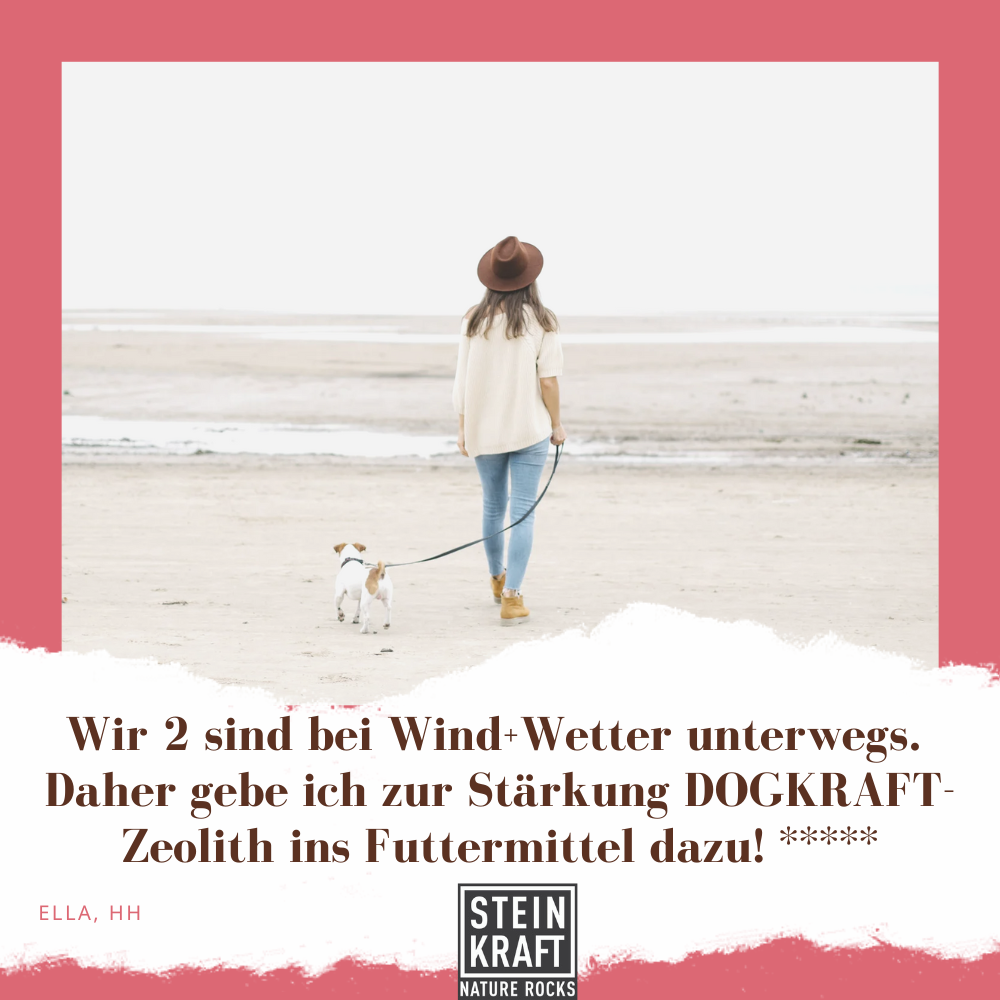
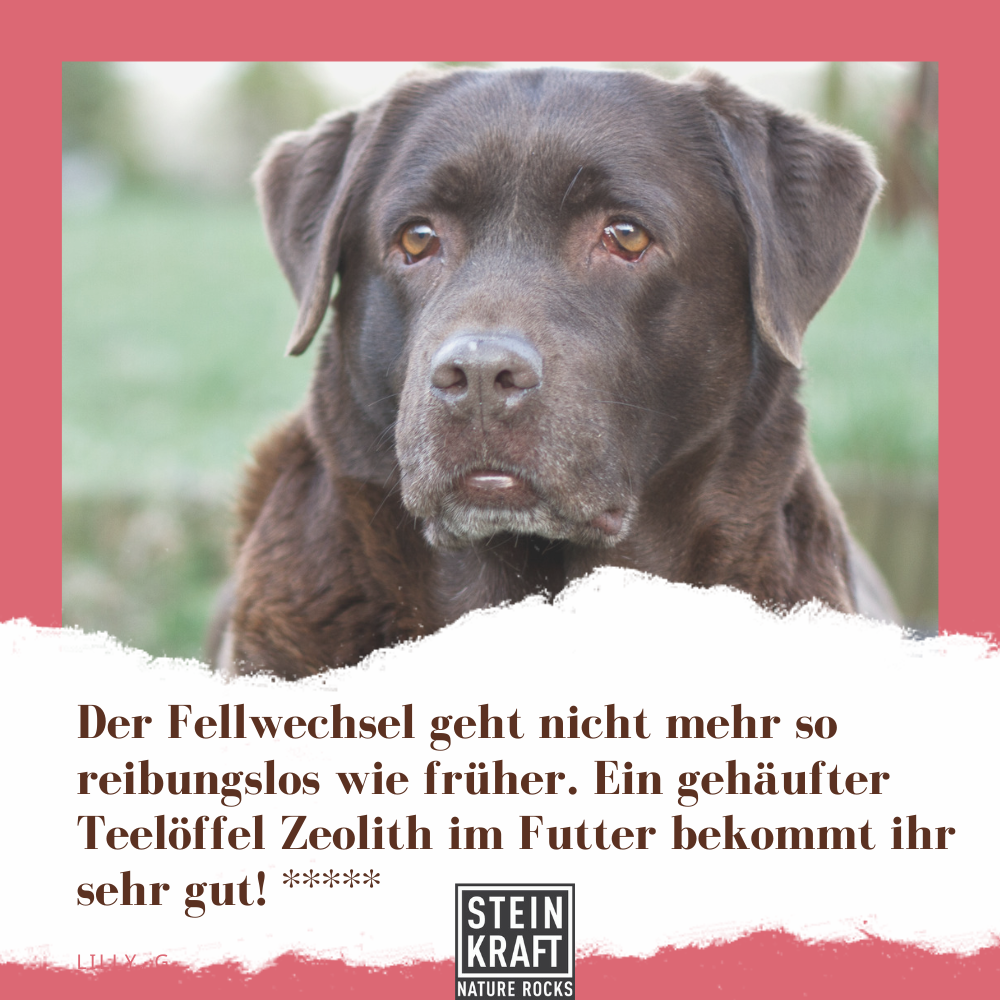
Ezra has been getting zeolite since he came to us. Not because something was wrong, not because he was sick or we were worried – but because a puppy in a city daily takes in things that are invisible yet end up in the body. Heavy metals from tire abrasion on the asphalt. Germs from the soil in parks where other dogs have been. Residues that accumulate over time, silently and unnoticed.
Zeolite binds these substances in the intestine – before they enter the bloodstream. This is not an extra or a luxury; it's a form of daily care that costs little and means a lot. Simply mix it into the food, and you're done.
And if he ever had diarrhea, after a vaccination for example, or an unknown treat – a little more zeolite, and rest, and the confidence that the body knows what it's doing when given support.
The vet looks into Ezra's mouth at every check-up and is thrilled. About his teeth, about his condition, about this dog who, at six years old, still looks like he's just arrived. Is it the zeolite? Partially, perhaps. Is it the love and attention? Definitely also. Both together make the difference – as always, when you accompany another being.
What Ezra taught us – what no guide will tell you
A dog moving in changes everything, and that sounds like an exaggeration until you've experienced it yourself. The rhythm of the day. The question of whether you still go out in the evening or prefer to drive home because someone is waiting. The priorities that quietly shift without you noticing, until you realize at some point that these were the best shifts you ever allowed.
Ezra teaches responsibility without theory, patience without explanation, presence – because he is always in the now and reminds us daily that the now is the only place where life truly happens. He doesn't think about yesterday, he doesn't worry about tomorrow. He thinks: Ball. Mom. Dad. Marika. Now.
Andreas sleeps on the floor. Michaela drags him into the crate. Marika brushes him lovingly, sees all his aches and pains first, and Steffi says: two fingers, calm, clear. Everyone different, all right, and Ezra – help from God – has learned to deal with everyone, to read everyone, to give everyone what the encounter needs. Of course, he loves the children who play carrot street with him, practice self-efficacy, and enjoy seeing impulse control from the outside. A carrot on each paw and a piece on his head. Ezra Bravo! And when he gets too much cuddling, he comes to me and tells me everything. Mom, did you see that. Yes, I did. That's part of it, my dear.
Perhaps that is the greatest lesson of all: There isn't one right way to love or accompany a dog. There is only the effort, the attention, the observation. And a being that starts anew every morning – without resentment, without reproach, without the burden of yesterday – and simply asks: When do we start? 🐾🧡
References
| No. | Author / Year | Topic | Source |
|---|---|---|---|
| 1 | Alexandra Horowitz (2009) | The "guilty look" – no remorse, but reaction | Behavioural Processes, 74(3) |
| 2 | Harvard University (2020) | Early Experiences & Adult Behavior | Applied Animal Behaviour Science |
| 3 | Pavlov, I.P. (1927) | Classical Conditioning | Conditioned Reflexes, Oxford University Press |
| 4 | Song & Yoon et al. (2026) | Cortisol & Stress in Dogs | PLoS ONE |
| 5 | Bergström et al. (2022) | Dog Domestication | Nature |
This article does not replace advice from a dog trainer or veterinary recommendation. It is meant to accompany – not replace.
Read more:
👉 What dogs really feel – and why we so often misinterpret it
👉 Dog in the city – Ezra & the escalator
👉 What we can learn from dogs
Still a question? 🐕
Perhaps your exact question has already been answered – on our large FAQ page about STEINKRAFT Zeolite. There you will find everything about quality, dosage, and application for humans, animals, and gardens. And if not: just write to us. We will reply personally.
👉 To the FAQ page →