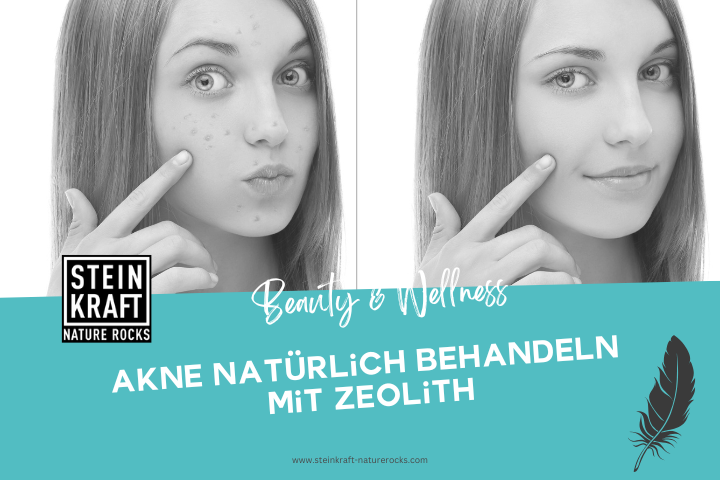
When skin is irritated, reddened, or overwhelmed—whether due to environmental toxins, minor wounds, or inflammation—we often wish for gentle yet effective help. Zeolite, a natural volcanic mineral, has been valued in natural medicine for centuries. Today, modern research also confirms: Zeolite can do much more than previously thought.
In this article, you will learn what scientific studies show about the effects of zeolite on the skin—and why our high-quality zeolite powder can be valuable support for your skincare.
What is Zeolite – and why for the skin?
Zeolite – here we always refer to clinoptilolite – is a microporous mineral of volcanic origin. Its crystalline structure acts like a fine-mesh sponge: it can bind pollutants, excess oil, germs, and even heavy metals. This makes zeolite excellent for external use on the skin – especially when it is irritated, dirty, or inflamed.

For everyone who wants to know more and also wants to crawl through the study situation, we have put together this list. Also for those who want to develop their own opinion and their own attitude towards this mineral. There is so much superficial and sometimes incorrect information to read on the internet - therefore I plead: develop your own intuition.
Wound Healing: Safety & Tolerability
Wound treatment and healing is one of the most thoroughly researched areas of application for zeolite.
Study Design & Results
-
In-vitro and animal models: Laboratory studies show that clinoptilolite zeolite can absorb wound exudate and bind bacteria and their toxins. In in-vitro experiments, for example, it was shown that zeolite can adsorb not only microorganisms but also bacterial toxins and odor-producing molecules. Animal experimental studies on rodents showed that clinoptilolite-containing preparations can promote wound healing. For example, zeolite-containing hydrogel layers in a rat model for burn wounds accelerated healing compared to untreated controls (faster re-epithelialization, granulation tissue formation, etc.).
-
Clinical studies (wound healing): Initial clinical investigations suggest that zeolite is safe and well-tolerated in wound treatment. In a prospective, randomized Phase I study (open, controlled) on 12 healthy subjects with artificially created skin wounds, topically purified clinoptilolite tuff (a nearly pure clinoptilolite zeolite, in powder form) was compared with standard therapy (NaCl rinse + dressing).
Result: Zeolite treatment proved to be safe and well-tolerated, with no significant differences in wound healing time or quality compared to standard treatment. Histologically, however, some differences were found: significantly more macrophages and fewer myofibroblastic cells were detected in zeolite-treated wounds. Occasionally, tiny zeolite particles were detected in the newly formed dermal tissue, without them disturbing healing or causing clinical symptoms.
The authors conclude that purified clinoptilolite could be a cost-effective, safe wound therapeutic that supports the healing process. – An earlier observational study of 33 patients with chronic or infected wounds (acute and chronic mixed) also reported positive trends: under the application of a clinoptilolite wound powder, a reduction in bacterial load and an improved wound healing tendency compared to baseline were observed over several weeks. Due to the small case number, statistical significance was limited, but an antimicrobial effect of the zeolite powder was suspected. Overall, the zeolite powder in this study was well tolerated, with no relevant side effects; a favorable local tolerability profile and few side effects were noted. -
Special Wound Healing Scenarios: Zeolites have also been tested in special contexts. In a diabetic rat model for poorly healing bone defects (tooth extraction), locally applied clinoptilolite significantly accelerated bone regeneration in the tooth socket. The zeolite contributed to improved bone regeneration. This indicates that zeolite could have a positive effect not only on soft tissue but also on the healing of hard tissue (indirectly through improved wound conditions).
It is important to emphasize that zeolite does not work miracles in wound healing, but can make a supportive contribution as an absorbent, antimicrobial wound additive – especially to absorb exudate, bind odor and germs, and promote a moist wound environment.
Sources:
1. A clinical study with 12 healthy subjects investigated the effect of clinoptilolite powder on artificially created skin wounds.
Study: Deinsberger et al. (2022)
Zeolite type: tribomechanically activated clinoptilolite
Application: Powdered, applied directly to artificially created skin wounds
Procedure:
- 12 healthy subjects received small, standardized skin wounds (like a superficial abrasion).
- One side was treated with zeolite, the other with saline solution and a dressing (standard therapy).
- Observation over several days.
- Skin samples were also examined under the microscope.

Result:
- Zeolite was just as effective as the standard treatment.
- No side effects, very good tolerability.
- Microscopically, it was shown that zeolite positively influences wound healing, e.g., by increasing immune cells (macrophages) in the tissue.
Few zeolite particles were found in the tissue, but without negative effect.
Result: Zeolite was just as effective as a standard medical treatment with saline solution. It was well tolerated, showed no side effects – and under the microscope, there were even indications of an activated immune response that can support healing.
Here I have the original abstract from [Deinsberger et al.]. Also to show the perspective the researchers take and because the energy of the study comes across well. So:
"In an aging society, chronic ulcers represent an increasingly relevant health problem associated with significant morbidity and increasing financial burden. Therefore, there is an unmet medical need for new, cost-effective therapies to improve the healing of chronic skin wounds.
This prospective, randomized, open-label Phase I study investigated the safety and tolerability of topically applied purified clinoptilolite tuff (PCT), consisting mainly of the naturally occurring zeolite mineral clinoptilolite, in artificially induced wounds in healthy male subjects compared to standard of care (SoC).
We found that topical application of clinoptilolite zeolite in acute wounds in healthy male subjects was safe for therapeutic use. There were no significant differences in wound healing or wound condition compared to wounds treated with standard care.
However, in the zeolite-treated wounds, we found a significantly higher proportion of CD68-positive cells (macrophages) and a significantly lower proportion of α-smooth muscle actin-positive cells (myofibroblasts). Scanning electron microscopy occasionally showed PCT particles in the restored dermis. However, these neither impaired wound healing nor led to clinical symptoms.
Therefore, zeolite could represent a promising, cost-effective wound treatment that promotes the healing process."
This study shows that tribomechanically activated zeolite is safe and well-tolerated on the skin – even with small wounds. Its moisture-binding, irritation-reducing effect is proven.
I find this to be a strong argument: Zeolite supports natural skin healing.
What does this mean in practice?
STEINKRAFT LIFEKRAFT Zeolite contains the same "zeolite type" - namely tribomechanically activated zeolite - as in these studies - and offers a natural way to gently soothe sensitive or irritated skin. A very cost-effective alternative for wound treatment. And natural.
2. Observational study on chronic and acute wounds
Study: Becher et al. (2019)
Zeolite type: tribomechanically activated clinoptilolite, as powder
Application: 1–2 times per week on chronic wounds of 33 patients
Procedure:
- In a dermatologist's office, patients with poorly healing or infected wounds were observed.
- The zeolite powder was sprinkled on the wound, then covered with a dressing.
- Progress documented over several weeks.

Result:
- Wounds often healed better and faster.
- The bacterial load decreased, and the wounds dried out.
- No skin irritations or side effects.
What this means:
The effect of zeolite as a wound protection powder is clearly demonstrated here. Especially for weeping skin areas, irritations, or even open skin areas (e.g., in eczema, neurodermatitis), a high-quality zeolite powder can help soothe the skin and reduce bacteria and odor.
Zeolite for inflammatory skin conditions (eczema, dermatitis)
Inflammatory skin diseases like atopic dermatitis (neurodermatitis) or psoriasis are primarily driven by impaired skin barrier and inflammatory reactions. Zeolite is experimentally tested here as an anti-inflammatory, adsorbing additive:
-
Atopic Dermatitis (Neurodermatitis): Until recently, there were no studies on zeolite for neurodermatitis. However, in 2021/2024, a mouse model of atopic dermatitis (induced allergic skin inflammation) was investigated: Topically applied clinoptilolite powder was compared to the standard therapy tacrolimus ointment.
Result: Both therapies significantly reduced skin inflammation compared to untreated animals. Notably, the anti-inflammatory effect of the zeolite powder was comparable to that of tacrolimus – clinical skin score improvements and histopathological findings did not differ significantly between the zeolite and tacrolimus groups (with a clear improvement compared to the dermatitis-only group).
This suggests that zeolite can alleviate inflammatory processes of the skin. The proposed mechanisms of action include the absorption of inflammatory mediators and a barrier-protective effect. Clinoptilolite could, for example, bind irritating substances or allergens on the skin, thus reducing the immune reaction. In addition, no side effects were observed; the powder was well tolerated (no additional itching or burning). Of course, tacrolimus is a potent immunomodulator – that zeolite was similarly effective is promising, but needs to be confirmed in further studies (ideally in humans). -
Contact Dermatitis and Anti-Inflammation: Similar to neurodermatitis, zeolite could also be helpful in irritant or allergic contact dermatitis by adsorbing toxins or allergens. In the mouse model mentioned above, for example, a chemical was used as an allergen; zeolite was apparently able to curb the resulting skin reaction. In addition, individual doctors and, above all, our customers report improved wound healing in eczematous, weeping skin areas by sprinkling zeolite powder – which is plausible, as it binds moisture and exudate and keeps the skin dry. However, systematic clinical data are lacking. In the cosmetic field, zeolite is sometimes incorporated into creams for sensitive skin, with the promise of binding skin irritants (e.g., heavy metals, environmental toxins) and mitigating inflammatory reactions.
For example, a proof-of-concept study investigated the heavy metal binding by zeolite in skincare: A fine clinoptilolite powder was added to creams, which were applied to the skin and then analyzed for bound metal ions (nickel, lead).
Result: Zeolite was able to bind significant amounts of nickel ions from a simulated exposure, indicating that it can serve as a pollutant filter in anti-pollution creams. This is particularly relevant for people with nickel allergies or in urban, heavy metal-polluted environments. The study (Pesando et al. 2022) thus confirmed that zeolite in cosmetics can intercept environmental toxins before they penetrate the skin – a skin-protective effect that could prevent inflammation caused by these substances.
🐁 3. Atopic Dermatitis Study with Mice
Study: Turkoglu et al. (2024)
Zeolite type: tribomechanically activated clinoptilolite zeolite in fine powder form
Application: Applied to inflamed skin once daily
Procedure:
- Mice were artificially induced with "atopic dermatitis".
- One group received zeolite powder, one group a cortisone-free medical cream (Tacrolimus), and one group nothing.
- Skin changes were evaluated (redness, scaling, itching) and examined microscopically.

Result:
- Zeolite was just as effective as the medical cream.
- Inflammation receded, skin appearance improved.
- No side effects, good skin compatibility.
What this means for zeolite:
For inflamed, irritated, or itchy skin, zeolite can have a soothing effect – without cortisone or synthetic active ingredients. Zeolite powder is a great advantage in natural skin care, especially for people with a tendency to atopic dermatitis or sensitive skin. Natural and also cost-effective effective support for eczema.
🧴 4. Cosmetic Study: Zeolite protects against heavy metals (detox effect)
A study investigated how well zeolite in skin creams can bind heavy metals such as nickel or lead.
The result: Zeolite acted like a magnetic protective film and prevented the toxins from penetrating the skin. For anyone living in cities or sensitive to environmental stimuli, this is a strong argument.
What this means: Zeolite can bind pollutants, particulate matter, and irritants before they burden the skin – ideal for protective daily care.
Study: Pesando et al. (2022)
Zeolite type: Micronized natural clinoptilolite
Application: Incorporated into face creams
Procedure:
- Cream with and without zeolite was applied to test areas.
- Then the skin areas were "loaded" with nickel or lead solution.
- The amount of heavy metal that penetrated the skin or was bound was measured.

Result:
- The zeolite-containing cream could bind significantly more heavy metals than the comparison cream.
- The zeolite acted as a protective shield against environmental toxins.
What this means for our Lifekraft Zeolite:
The zeolite powder not only has a mattifying effect, but can also bind particulate matter, heavy metals, and other environmental toxins before they penetrate the skin – a real argument for a "detox" or "anti-pollution" skin care.
🌿 5. Zeolite as an active ingredient carrier against acne - Ideal for blemished skin: Zeolite binds oil and supports antibacterial substances
In laboratory studies, zeolite was combined with zinc or natural antibiotics to treat acne. The zeolite acted as a carrier system – it stored the active ingredients and released them slowly. Although our zeolite powder does not contain medication, its mineral structure is excellently suited to support essential oils (e.g., tea tree oil) or herbal active ingredients. We have a skin powder with organic lavender oil and for horses a hoof powder with organic tea tree oil.
Study: Bonferoni et al. (2007)
Zeolite type: Zinc-enriched clinoptilolite zeolite
Application: As a carrier system for zinc and antibiotics in creams
Procedure:
- Zeolite was "loaded" with zinc or erythromycin.
- The release of these active ingredients was tested on artificial skin and in ointment bases.

Result:
- The zeolite released the active ingredients slowly and evenly.
- Stable and well-tolerated.
- Particularly suitable for long-lasting, antibacterial effects.
Conclusion: Skin care with efficacy – gentle, safe, and natural
The study situation is clear: zeolite has a supportive effect on the skin. Whether for small wounds, itchy areas, environmental stress, or oily skin – the mineral helps the skin regulate itself.
Our zeolite powder contains only high-purity clinoptilolite zeolite of tested quality. It is free of fragrances, without preservatives, and also suitable for sensitive skin. And best of all: Its effect is natural – and scientifically proven.
💬 Testimonials *****
"I use the zeolite powder daily for sensitive skin areas. It instantly soothes and also helps me with small skin injuries. I wouldn't want to be without it." – Maria R., 56 years old
👉 Here you can find the product of the month and a good overview of all STEINKRAFT areas
👉 Here you can find all STEINKRAFT products at a glance - directly in the shop